Tips for your AP Exam Friday Review Sessions
It’s that time of year! The days are getting longer, the coffee is getting stronger, and the AP Exam is looming just around the corner. While “rigor” is the word of the season, prep doesn’t have to be a struggle of silent, solitary practice.
If you’re looking to shake up your review routine, why not try “FRQ-Y FRIDAYS”? Here are four collaborative, high-energy ways to help your students master Free Response Questions while building their confidence.
1. The Power of Progression: 1-2-4-Day
This is a fantastic “Single-Double-Quadruple” strategy that eases students into difficult prompts. It’s perfect for your year-end review strategies, when students have the knowledge to tackle most topics. Here is the process for this approach:
Independent (5-7 mins): Students fly solo on an FRQ.
Partners (5-7 mins): They pair up to compare notes and fill in gaps.
Groups of Four (Final phase): Two pairs merge to finalize the best possible answer.
The Finish: Collect one collaborative paper for a group grade or go over the scoring guidelines together. It’s a low-stakes way to ensure everyone understands the “why” behind the points.
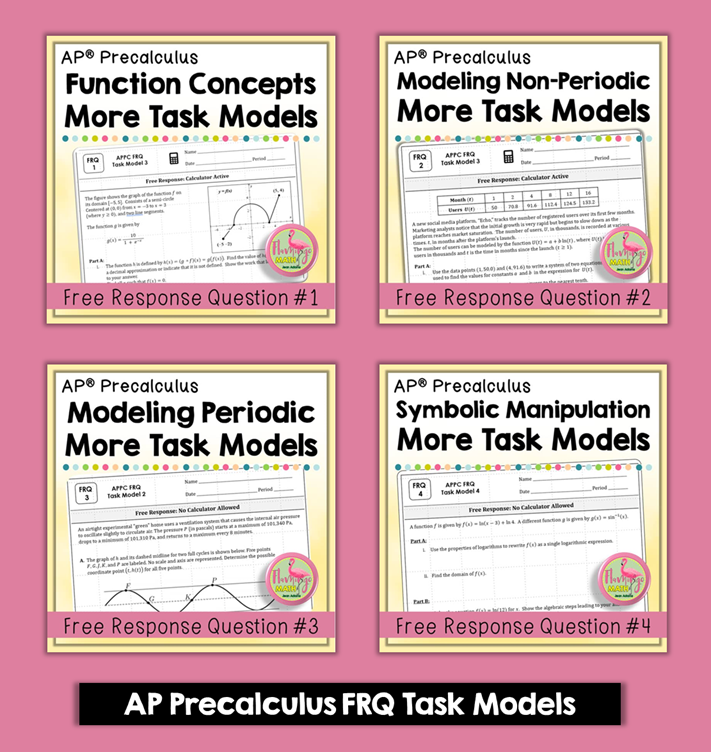
If you teach AP Precalculus, take a look at the latest addition of Task Models for each FRQ tested:
2. FRQ Four-Square Friday
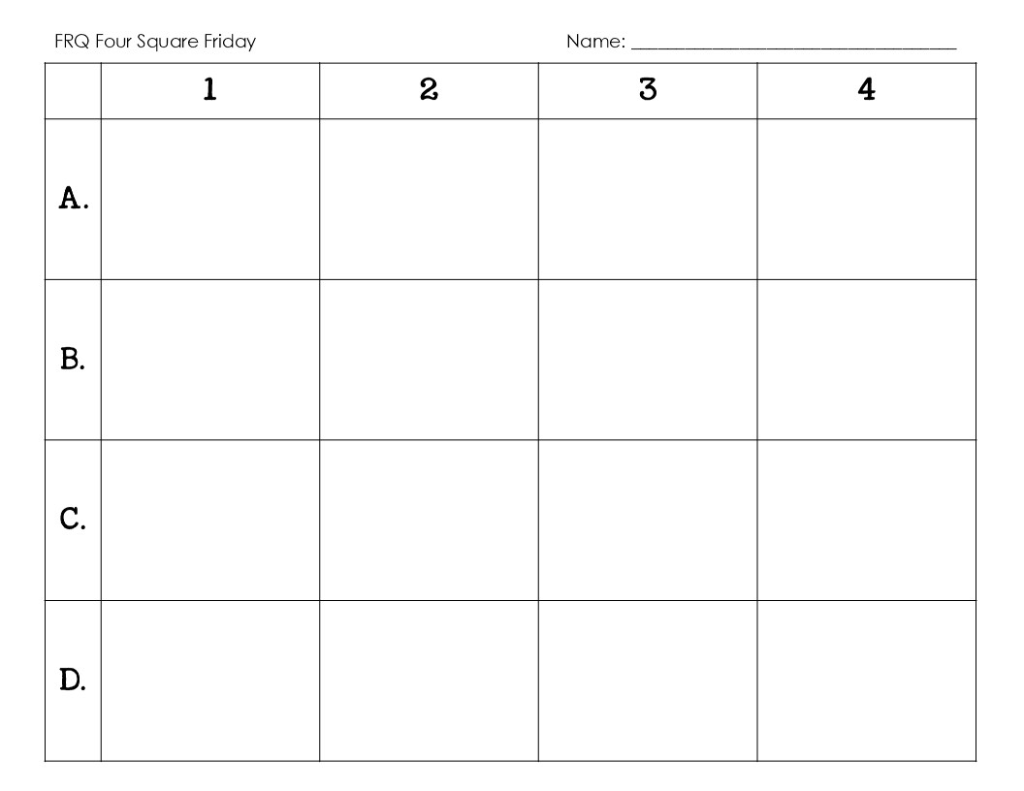
Turn review into a game! Find four different FRQs that each have four sections (a–d). If they don’t have four parts, just add or delete a section to make it fit.
The Grid: Students work in groups to fill out a 4×4 grid.
The Scoring: Make it competitive! You can award 2 points for a correct answer, 10 points for a full row or column, and even “Magic Square” bonuses.
Pro-Tip: Randomly choose one section as a “Bonus Score” to keep them on their toes!
3. The FRQ Station Rotation
If you want to cover a lot of ground quickly, set up stations based on the 7 Big Ideas for AP Calculus or 4 Task Models for AP Precalculus.
The Flow: Set up 5-7 stations around the room and have students rotate every 15 minutes.
The Focus: Choose questions that build confidence. You can even eliminate the most grueling sub-sections to keep the momentum high.
The Goal: By the end of a 50-minute period, students have touched on multiple “STEM-Types” and seen the breadth of what the exam might throw at them.
If you teach AP Calculus AB or BC, you might like to have this ALL NEW SET of 10 FRQ’s to get your review underway for the 2026 AP Exam. Take a look HERE.
4. Gallery Graffiti
Get them out of their seats! This strategy turns your classroom walls into a living answer key.
Set the Stage: Post FRQ prompts on large chart paper or whiteboards around the room.
The Work: Teams of 3-5 students spend 15 minutes at a station tackling a prompt.
The “Peer Review”: Groups rotate to a new station to review and critique the previous team’s work. Use sticky notes or different colored markers for “Graffiti” comments.
Accountability: Have students sign their names next to their contributions or switch “recorders” at every station to keep everyone engaged.
Which of these are you trying first? If you need help tailoring one of these strategies to a specific unit or topic, let me know—I’m happy to help you brainstorm some prompts!