Preparing for the AP Precalculus exam is as much about mastering the “behavior” of functions as it is about getting the algebra right. Since this is a newer AP course, the focus is heavily on multiple representations—switching between graphs, tables, and symbolic expressions.
Here is a guide to help you navigate the home stretch with confidence.
Strategies for Success
1. Master the “Rates of Change” Language
AP Precalculus places a huge emphasis on how things change. Don’t just look at the values; look at the change in the change.
- Linear: Constant rate of change.
- Quadratic: Constant second differences (the rate of change is changing at a constant rate).
- Exponential: Constant proportional (percentage) bof change.
2. Know Your Regressions
The exam often asks you to find a model for data. Be comfortable using your graphing calculator to perform:
- Linear, Quadratic, and Cubic regressions.
- Exponential and Logarithmic regressions.
- Sinusoidal regressions (especially for periodic data like tides or temperatures).
- Tip: Always check if the question asks for the model to be written in a specific form, such as f(x)=abx or g(x)= a*logb(xy).
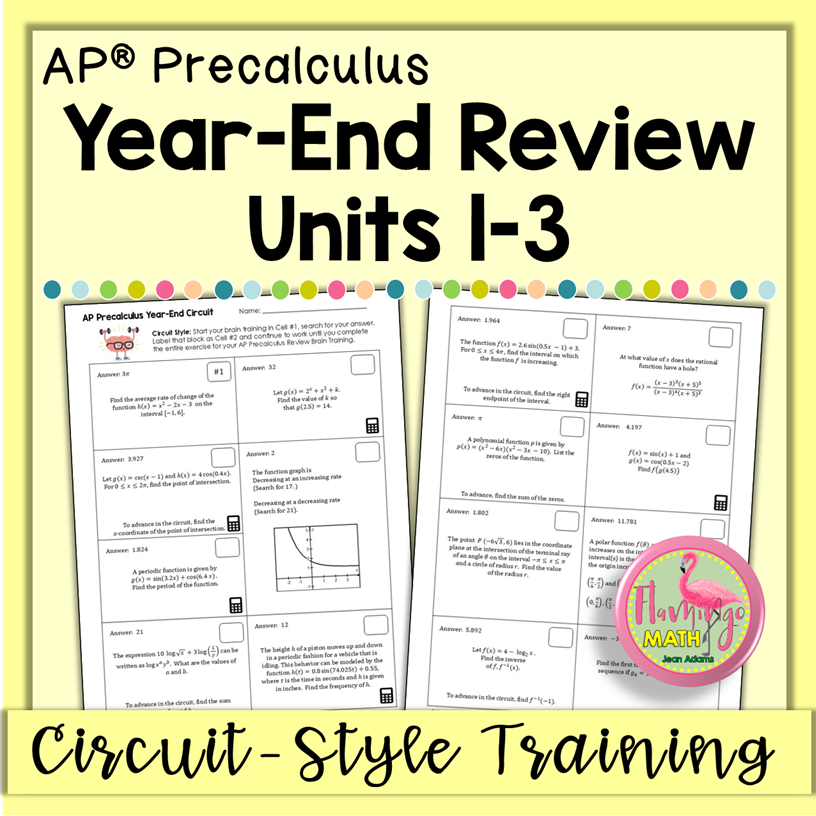
AP Precalculus Year-End Circuit Review Activity
3. The Unit Circle is Your Best Friend
Trigonometry (Unit 3) is a massive part of the exam. You should be able to recall the sine, cosine, and tangent values for all special angles without hesitation.
- Understand the relationship between arc length, radians, and degrees.
- Be able to transform trigonometric functions: y= a sin[b(x+c)]+d.

4. Understand Limits and Continuity
You don’t need to know the formal definitions from Calculus, but you must understand End Behavior using limit notation when confronted with the AP Precalculus language
- Watch for statements like, “as the input values increase/decrease without bound.”
- Identify Vertical Asymptotes (where the output values increase/decrease without bound). The values of x that make the denominator equal to zero
- Identify Holes (removable discontinuities). In a rational function, notice that the factors which are equal or have larger powers in the numerator will result in a hole in the graph.
Exam Day Practical Tips . . .
- Calculator Settings: Ensure your calculator is in Radian Mode unless a specific problem explicitly mentions degrees. Most AP Precalc problems assume radians.
- Show Your Setup: On the Free Response Questions (FRQs), the “method” is often worth more points than the final answer. Even if you use your calculator to solve an equation, write down the equation you are solving (e.g., “Set f(x)=10”).
- Don’t Round Too Early: Store results in the calculator. Keep as many decimals as possible during intermediate steps. Round to the three decimal places required by the AP standard only at the very end.
- Watch the Clock: The Multiple Choice section has a “No-Calculator” and a “Calculator-Active” portion. Pace yourself so you don’t spend 10 minutes on one tricky trig identity.
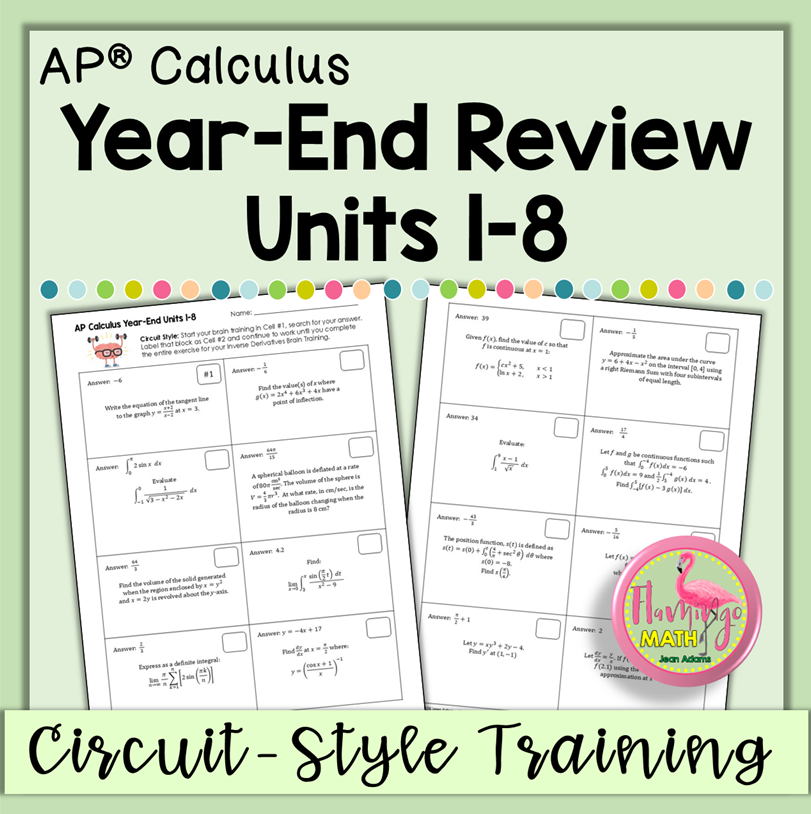
AP Calculus AB Year-End Circuit Review Activity
While the tips in this post are geared toward our AP Precalculus students, I can’t forget those who teach AP Calculus. Here is an added surprise for you if you also have a need for the AB Topics in units 1-8.
A Final Word of Encouragement!
You have spent the entire year building a toolkit to describe the world through mathematics. This exam isn’t designed to “trick” you; it’s designed to let you show off your ability to analyze patterns.
If you hit a problem that looks confusing, take a breath and ask yourself: “What is this function doing?” Whether it’s growing, decaying, or oscillating, you already have the tools to describe it. You’ve put in the work—now go finish strong!
Stay focused and stay strong!